

Healthy living
-
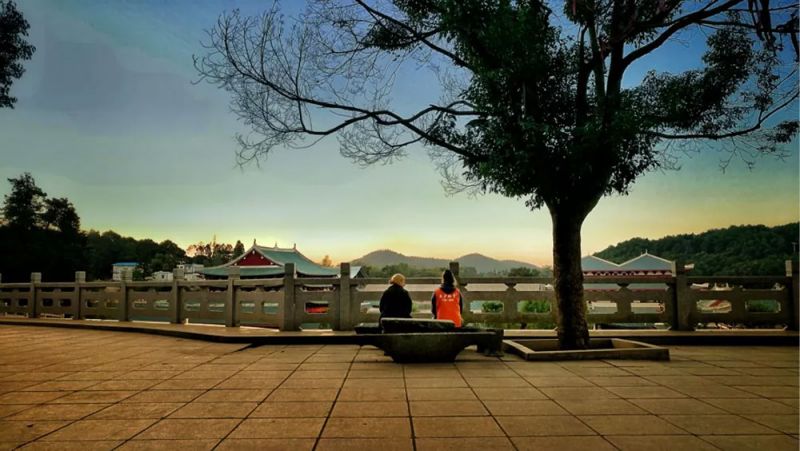
Essence of Zen Answering
How long does meditation last? Is it possible that the order hasn't been finalized in three hours? Do you want someone to wake you up?Not necessarily. It's been three hours and you haven't made a decision yet. This is something you came up with on your own. Don't think about it yet, be honest. You can sit for as long as you can do it now.What should I do if my feet get numb during the process of meditation?If you are not very numb, we need to accept it. If you are numb, it will affect your calmness. You can slowly adjust your posture and change it.03 Mindfulness meditation requires a process. When entering the preparation state for meditation, the master just said, "Observe the nose with your eyes, observe the heart with your nose." This is not easy for us to achieve at the beginning. Can we first calm down by reciting scriptures?This is not necessary, it already lacks mindfulness. That's the way to distract you, like tying a monkey with a rope, slowly fixing the monkey's lively and energetic nature in a place through the rope. The monkey starts jumping around because it's not used to it, but because the rope is fixed in one place, it gradually gets used to it, and the heart becomes calm.By observing our breath, we can pay attention to it, which is itself the best way to train mindfulness. Don't think about anything else, it's all mixed in. So we must know that our method itself is the most direct way to train our mindfulness, so that our minds are no longer scattered or restless.How is breathing done when the tongue is on top of the palate?Just now we guided the tongue to touch the palate, which is slightly behind the upper front teeth. It can be placed on top without touching or exerting too much force. We usually inhale through the nose and exhale slowly through the mouth, during the first three breaths.Inhale slowly with your nose, and exhale slowly with your mouth. This is a process of adjusting your breath, so don't hold your breath, it's very natural. When you are already full, slowly and slowly exhale, then when you have vomited to the end, naturally and slowly inhale again, and when you are full, slowly exhale again.05 also has a problem with sitting posture. I feel like I'm leaning forward as I sit. What should I do?This is very natural because we are not used to it, so this body adjustment can be done throughout the entire process, not just sitting down and not moving. In the process, I learned that when I found it, I slowly adjusted it. I felt that the head slowly tilted to the left, to the middle, to the right, and then to the middle. My head slowly lowered and slowly adjusted. Be aware that the entire process needs to be done.(Student: Will this affect entering meditation?) Don't expect to enter meditation. It's not easy to do these skills well first, because of their own awareness. Don't have a misconception about entering meditation, as if entering meditation means not moving anything. In fact, what Buddhism teaches about positive mindfulness is to cultivate our mindfulness through observation of this activity.What does' ding 'mean? Our hearts can see clearly the experience of any activity, without being disturbed by these activities and experiences. Interference, such as wanting to grab something comfortable, is the act of exerting force, and the heart is exerting force; Seeing something uncomfortable and rejecting it is also exerting force and interference. So through observation, we can see the movements of our heart. If there is force, greed, or resistance, we slowly let go and let the natural heart rest on our breath.Everyone should pay attention because each person's problem may represent your own problem.On the first day of meditation and today's meditation, when entering the state, the body naturally shakes 360 degrees. It's very comfortable to be aware of this and to sway consciously and naturally.Natural shaking of the body, realizing that it is very comfortable, natural shaking is okay, don't deliberately shake because of comfort, that's not good. Encountering some people who have been shaking involuntarily, let's not control it. Just realize that I need this kind of movement now, it's okay. Don't keep shaking like this just to feel comfortable.So, the occurrence of this phenomenon is also an action. Be aware of it, be aware, and then go and see if this action is comfortable for my current body. If it feels comfortable, then it is enough. If it is other reasons that make our hearts uneasy, then we need to adjust and let our hearts calm down.What is the best time to meditate every day?Waking up in the morning is the best, because after a night's rest, the spirit will recover well, it is not easy to sleep, and the spirit will be full.At night, it depends on the situation. If you are too tired from working during the day, it is not appropriate to meditate. If you are not very tired, you can meditate before resting. If you have poor sleep, meditation can help you adjust and relax your body and mind, which is beneficial for sleep.I saw some friends in Taiwan who have been doing things all day and are very tired. They still need to do things. They will meditate for ten minutes and then start doing things. Is this okay?This also has an effect. Meditation allows the mind to rest, and when the mind rests, our body is more likely to relax. Our hearts are constantly running around and tired, our body muscles are tense, and a tight heart and body are actually the most energy consuming.This is effective, but it will require effort. For example, if you are usually in the office and have been working for one or two hours in the morning, you can close your eyes and rest, sit naturally or cross legged, then relax and adjust your body to be comfortable and relaxed, breathe naturally, pay attention to the expansion and contraction of your abdomen, and don't think about anything else or care about anything else. For example, if I only have ten minutes, then during these ten minutes, I am very focused and let my heart train on breathing, without thinking about anything else. That's great.If possible, everyone is a layman at home, and there is a lot of time that you cannot do. We can use fragmented, even five minutes, or even advocate for one second mindfulness training. For example, when speaking, we don't even know how to mention mindfulness. The tone of our speech was too forceful and too urgent, and then we relaxed and slowed down our pace. This is also mindfulness; Walking is very hurried and nervous. I realized that I was too nervous and anxious just now, so I maintained mindfulness, adjusted my posture, and slowed down my pace. This is mindfulness training, which needs to be done constantly. We spend dedicated time to experience and truly cultivate our mindfulness in our daily lives, so that it is connected to our lives.We should always mention mindfulness. Mindfulness means that when walking, you should pay attention to walking, and when eating, you should also know how to eat and how to eat? For example, when I eat too fast and today's food is delicious, I feel anxious and thirsty, constantly consuming to gain that beauty, and my heart is very strong. At this point, become aware, then slowly savor, chew, and swallow, maintaining mindfulness throughout the entire process of eating.Regardless of the activity, there must be mindfulness. In this way, you will feel that the taste of the meal will be different and better. We usually eat with anxiety, hunger and thirst. When we eat, we devour the fruits of Ginseng fruit and eat them together with Zhu Bajie. In fact, you can't feel the taste, which is a real delicacy. That is to say, mindfulness is very important, and eating is very important. This is an example that we need to constantly mention in our daily lives.There is a saying in meditation that is very important. You should always mention what you are currently doing? This is a correct understanding - what am I currently doing? This is constantly reminding you to have mindfulness. We usually go and have a look. Regardless of whether you work, walk, eat, or talk, we usually don't have mindfulness. We are completely constrained by our own desires or desires when doing these things or activities.For example, I am speaking here to showcase my own abilities, such as eloquence or knowledge, and to make you all like me. These thoughts are not mindfulness. If we are just saying that we need to constantly observe ourselves, your speech and expression are just to make everyone understand and comprehend the truth we are trying to convey. This requires us to have mindfulness to perceive and see what thoughts your heart is doing. If these thoughts are accompanied by some desires or subjective thoughts, your heart will exert a lot of force. We need to adjust that force accordingly. If your heart can calm down, then your heart won't be so restless.At the beginning of the first three breaths, inhale through the nose and breathe through the mouth. Do we need to do this when meditating later?The first three breaths are like this, just breathe naturally after meditation. When meditating, you must breathe through your nose. At that time, your mouth is closed and you can naturally breathe through your nose. If our tongue is on top of the palate, we always maintain that one. As you may have noticed, in traditional Chinese medicine, the Ren and Du meridians are connected, which makes it easy for our body fluids to fill up. When we meditate, if we are in a good state, we naturally salivate more. Sweet and sweet, it naturally plays this role.I just said why everyone should sit with their chin inward when sitting. What if my mouth feels dry when I meditate in the future? That's because when the head is lifted, the chin is tightly compressed, and sitting for a long time makes the mouth dry. When the chin is retracted inward, there will be a lot of body fluid, so it has this effect.Where is the best place to place both hands during meditation? Is it okay to lie down?Just feel comfortable. What we require is that as long as you find the most comfortable posture, you can do whatever you like. But this is the best (with folded palms in front), it makes our hearts more receptive. As long as it feels comfortable, everything else is fine.Is it okay to lie down? ——It's okay, as long as you don't sleep. We have reclining meditation, which can be practiced in walking, sleeping, sitting, or lying down. Sitting has sitting meditation, while standing has standing meditation. If sitting for too long is not good and the burden on the waist is too heavy, if conditions permit in the office, there is a place to lie down for ten minutes to relieve our lumbar spine. This is very good. Lie flat, breathe naturally, relax the whole body, and lie on the water surface. It is very light, very natural, and does not require any force to maintain awareness and clarity. This must be awake and not fall asleep lying there.(Student: I think about problems while lying down, my mind is very clear) - It's best not to think about problems, as they are very distracting and indicate that your mind has been troubled by that problem. Those that need to be adjusted and those that belong to bad thinking, thinking that it's good, are because your mind is fixated on something, forcing you to keep thinking about that thing, which is itself a kind of pressure. No matter what kind of Zen, it's about staying focused, maintaining mindfulness, observing carefully, and seeing what happens in your present moment and experience? This is very important.(Student: Is it possible to meditate anywhere with a strong inner strength?) Yes, theoretically it is, but it is really difficult for us to do so, so we need to take it step by step. Meditation, like eating, requires experiencing any way that is helpful for our mindfulness, allowing us to relax and calm our body and mind.11 mages, can the so-called 'thinking maintenance' solve problems in meditation?This question is very good. When we think about repairing, it's not the layman who was thinking about the problem just now, but a problem related to thinking and meditation. How can I continue to relax my mind and continue mindfulness? This is the right way. So we say that mental maintenance is not an ordinary way of thinking, it is the form before the initial meditation. This thinking is constantly adjusting to bring my mind into a more calm state, allowing my body to relax better. This is thinking, not thinking about the greed and persistence in other work in the world, which is not good. This is a good question, mindfulness thinking.So we're not saying that sitting in meditation doesn't have any thoughts at all, we're saying that there are rules and reasonable ways of thinking.Okay, the time has come. It's a great fate and honor, a rare encounter in one's life. Every moment we spend together and every fate we have cannot be repeated. We should cherish every day, every cause and circumstance, and every present moment. Through three days of meditation, we hope that each of us can stay away from scarcity and greed, and that our family, friends, and strangers around us can all stay away from greed and anxiety, and achieve inner peace. amitabha.Article | Organizing Self Illumination Master's 2018 Meditation Camp Presentation
MORE -
The origin of Zen tea
There is no clear historical record of the origin and generation of Buddhist tea drinking culture. In the Buddhist case, the earliest records of monks discussing tea tasting and Taoism can be traced back to the era of Master Huiyuan, the founder of Donglin Temple on Mount Lu in the Eastern Jin Dynasty. At that time, Duke Yuan was hidden in Mount Lu and had not left the mountain for thirty years; And famous scholars from various regions often gather at Mount Lu, thousands of miles away, to seek Zen and teachings from Lord Yuan, in order to gain his reputation; On the back mountain of Shidonglin Temple, there is a natural wild tea forest. Although there is no dedicated person to plant it, the tea fragrance is comparable to that of precious tea. Yuangong often uses this tea to entertain guests, and everyone drinks and teaches, often forgetting about it day and night. Rather than saying that people gathered at Mount Lu to visit the Tao, it is more accurate to say that many people went there for tea.Still starting from the Eastern Jin Dynasty. Master Daokai of Later Zhao Zhaode Temple, who never eats or falls alone at night; Drink only a few pills daily, accompanied by tea. Finally, even the pills were given up and only tea was served.However, there is a clear official record of the origin of the term "Zen tea" in the Zen sect:It was first passed down during the reign of Bodhidharma Patriarch——Bodhidharma Patriarch faced the wall for nine years, but after leaving, his eyes were not opened for nine years and his eyelids could not be opened. Therefore, he tore it off and threw it to the ground; A short tree grows at the spot where the eyelids fall. Brewing water from its leaves and drinking it can help the meditator clear their mind and understand the principles of Zen.Perhaps this is just a legend; But it laid the foundation for the origin of Zen and tea ceremony.
MORE -

Zen Tea Integration: The Relationship between Zen Buddhism and Tea Ceremony
The cultural connection between Zen Buddhism and tea ceremony has a profound historical background. In the early days, monks drank tea to understand poverty. With the passage of time, monks began to understand the relationship between the two from a cultural perspective and eventually developed the cultural concept of "one taste of Zen tea".Master Damo and TeaThere has always been a story circulating in Buddhism that when Bodhidharma Patriarch was facing the wall of Shaoshi Mountain, he was too tired and drowsy - his eyelids always fighting due to lack of pride. In a fit of anger, Patriarch Damo cut off his eyelids and threw them heavily to the ground. Unexpectedly, his eyelids grew into a tree as soon as they entered the ground. Later on, Master Bodhidharma realized that this small tree had been preserved, and his disciples began to pick its leaves for frying and drinking. Unexpectedly, it could have the effect of concentrating the mind, refreshing the mind, and stopping sleep. And this tree is a tea tree, and its leaves are naturally tea leaves.Of course, this is just a legendary story, but behind the story lies a profound Buddhist connection between tea ceremony and Zen Buddhism. After the rise of Buddhism in China, monks began to form an inseparable bond with tea due to the need for meditation, with the core concept of "one flavor of Zen tea". Therefore, when we talk about tea ceremony today, we naturally cannot leave Buddhism for empty talk, but should combine the two.Buddhism is not a religion that originated in China, it originated in India. When Buddhism was first introduced to China, there was no tea drinking tradition in temples. It was not until the emergence of Zen Buddhism and the need for monks to sit in meditation for long periods of time that tea drinking became popular in temples, creating conditions for the emergence of tea ceremony.Why do monks drink teaWhat are the reasons why monks drink tea? The legend of Bodhidharma Patriarch and tea to some extent answers this question.Zen emphasizes the practice of sitting in meditation, with focused thinking. Sometimes, a single meditation session can last for dozens of days, causing monks to inevitably become drowsy. In order to refresh and invigorate the mind, eliminate fatigue, and better meditate, they began to drink a peculiar drink. The Art Biography of the Book of Jin records: "The people of Dunhuang, known as Dan Daokai, were not afraid of the cold and heat. They often took small stones, which contained the fragrance of pine and osmanthus, and the tea they drank was just Su." Dan Daokai was a person from the Eastern Jin Dynasty. In history, he practiced meditation at Zhaode Temple and often took pills with the fragrance of pine, osmanthus, and honey. He also drank a drink called "Cha Su", which was made by boiling tea, ginger, osmanthus, orange, jujube, and other ingredients together. Tea can quench thirst and make people sleep less. Therefore, drinking tea has become an essential procedure for monks to meditate and practice Zen. With the development of Zen Buddhism, drinking tea has also become popular in society. This is because Zen Buddhism places great emphasis on the concept of roundness, which allows it to coordinate with traditional Chinese culture and absorb valuable resources from it. This has been reflected in the development of tea ceremony culture.——Taken from Han Bing's book "One Flavor of Zen Tea, Buddhism and Tea Ceremony"
MORE -
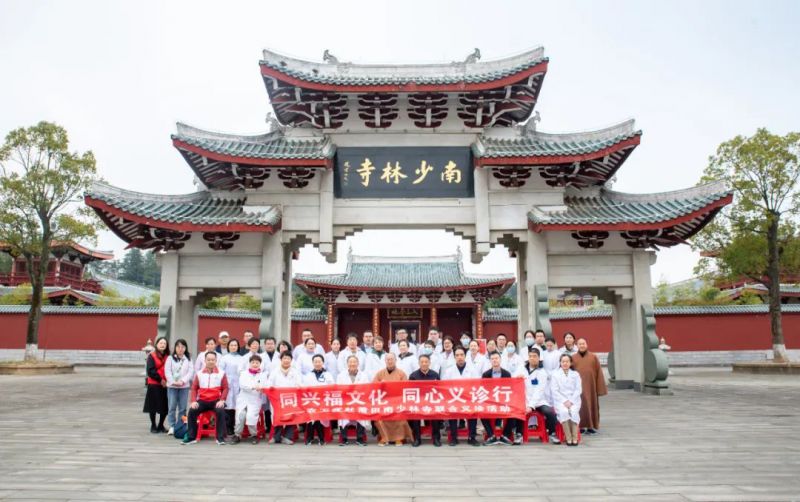
Tongxingfu Culture, Tongxin Free Clinic - The free clinic activity of medical staff from the Provincial Agricultural and Labor Party at the South Shaolin Temple in Putian was successfully completed
On December 7, 2024, the "Tongxingfu Culture, Tongxin Free Clinic" event was successfully held at the South Shaolin Temple in Putian, sponsored by the Fujian Provincial Committee of the Communist Party of China, the branch of the Fujian Medical University Affiliated Union Hospital, and the Putian South Shaolin Temple, and co organized by the Fujian Rehabilitation Hospital Branch of the Communist Party of China, the Putian College Affiliated Hospital, and the Putian Municipal Committee of the Communist Party of China. Yang Lin, the full-time vice chairman of the Fujian Provincial Committee of the Agricultural Labor Party, and Wu Jiantong, the full-time vice chairman of the Putian Municipal Committee of the Agricultural Labor Party, participated in this event. At 8:00 am, the Affiliated Hospital of Putian University and the Fujian Red Cross donated commonly used medicines and first aid kits and other medical supplies to the temple at the South Shaolin Inheritance Hall. Subsequently, more than 20 medical staff provided blood pressure and blood sugar measurements, thyroid examinations, vision tests, and other services to the monks, monks, volunteers, and nearby villagers in Linshan Village, covering 17 specialties. At the event site, medical staff patiently inquired and answered detailed questions, providing professional treatment advice based on everyone's physical condition, and guiding everyone to establish the correct health concept. At the same time, projects such as bone setting, massage, and cupping have been established in the Southern Shaolin Medical Hall, where everyone has received professional treatment, relieving discomfort and achieving significant therapeutic effects. The medical staff have received unanimous praise and recognition from everyone. At 11:20 noon, Deputy Chief Nutritionist Yang Ling and Director Zheng Minghua of the Provincial Red Cross Society respectively explained to everyone the scientific intake of nutrients needed by the human body in daily life, as well as methods for identifying and treating myocardial infarction and emergency treatment. After the lecture, accompanied by Master Kong Xing, the group came to the South Shaolin Inheritance Hall to watch the Zen and martial arts performance. Everyone felt the charm of martial arts and was deeply shocked. They applauded and took out their phones to record. This free clinic activity not only benefited the public and met the urgent need for medical treatment, but also promoted the Five Blessings culture of working together for blessings, promoting blessings, praying for blessings, harmonizing blessings, and gathering blessings. Kong Xing Da Monk expressed his hope to jointly organize more such activities with the Agricultural and Labor Party in the future, providing relief and warmth for grassroots people, promoting more high-quality medical resources to rural areas, and contributing to the construction of a healthier and more harmonious society.
MORE -
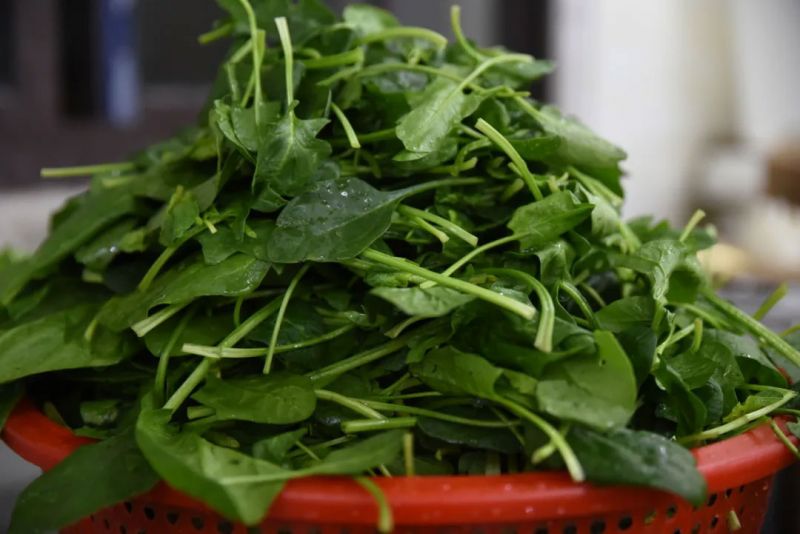
One of the Four Reasons to Eat Vegetarianism: Based on Health
Vegetarianism: indifferent to life, inner peace·Clear heart and few desires, wholeheartedly devoted to the Tao·Health: Four major harmonies, all roots are interconnectedThe great master of Buddhism, due to his vegetarianism, has a healthy body and a long lifespan. Some meat eaters may find it difficult to understand, but among scientifically minded medical and nutritionists, it is easier to comprehend.Firstly, vegetarian monks are willing to live a simple life, without the habit of indulging in clothing and taste. They have a clear mind and few desires, and are devoted to the Tao. As the saying goes, "Only by biting the fragrance of the vegetable roots can one know the taste." The seven emotions of joy, anger, worry, thought, sadness, fear, and shock are not easily moved in the chest, and the inner peace is the main spiritual factor that is not easily prone to illness. This also includes a set of Buddhist methods for cultivating the mind.In Buddhist scriptures, it is pointed out that vegetarianism can harmonize the four major aspects, promote the flow of qi and blood, increase concentration, "know the amount of food and drink", and "be content with less desire", which are essential conditions for achieving the divine power of meditation.Soy products and fruits in vegetarian diets are rich in plant protein, carbohydrates, calcium, phosphorus, and various vitamins, with high nutritional value and easy digestion and absorption. Among them, soybeans have extremely high functions, containing 40% protein, 20% fat and sugar, and rich in various vitamins, carotenoids, iron, phosphorus, calcium and other nutrients. The plant protein and fat of soybeans can reduce serum cholesterol, lower hypertension, and avoid heart diseases such as arteriosclerosis. So vegetarians can supplement their body's nutrition and improve their health by consuming legumes, grains, fruits, and other foods.In 2011, Elder Wei Xian published a paper titled "Buddhism and Vegetarianism" at the Second Chongqing Ancient Sword Forum, detailing the formation and development of the vegetarian viewpoint, as well as the influence of Buddhism on it. The Buddhist scriptures and practices of vegetarianism provide four main reasons for our vegetarianism: health, compassion, causality, and spiritual practice.Article source: Paper "Buddhism and Vegetarianism" from the 2nd Chongqing Ancient Sword ForumAuthor: Elder Wei Xian
MORE -

The second of the four reasons for vegetarianism: based on compassion
Vegetarianism: indifferent to life, inner peace·Clear heart and few desires, wholeheartedly devoted to the Tao·Compassion: Compassion is the foundation and convenience is the doorBuddhism is based on compassion and sorrow, with convenience as its gateway. The heart of compassion is generated through the wisdom of Prajnaparamita. Those who study Buddhism develop a bodhisattva heart of great compassion and universal compassion due to their understanding of the truth of karmic and karmic phenomena, and thus abstain from killing. The first of the five precepts is not to kill, and to adopt a vegetarian diet instead of killing is a positive behavior of abstaining from killing.In the Surangara Sutra, the Buddha tells his disciple Mahavairocana Bodhisattva:All flesh has an immeasurable fate, and Bodhisattvas should have compassion and not eat it. I am now speaking for you about its lack of points. Great wisdom, all sentient beings come from scratch and are constantly reincarnated in life and death. They have never been parents, men and women, family members, or even friends, lovers, or attendants. They are easily born and are subject to birds and animals, so why take them from them and eat them? Great Wisdom, Bodhisattva Mahasthamaprapta believes that all sentient beings are one and the same, and that all flesh comes from a destiny. Where can one eat? ……The meaning of this passage is: Firstly, all sentient beings are their own six relatives, friends, etc. from the beginning, and it is foolish and pitiful to do so just because they do not know how to eat in another life. 2、 He is me, equal to him. We should understand that his joys and sorrows are my joys and sorrows. We cannot ignore the pain of animals being killed just because we are addicted to food and drink. This is the most cruel thing.The great virtues of Buddhism and their predecessors have many poems about the prohibition of killing and releasing animals, fully reflecting the spirit of compassion. Here are three selected songs:My flesh is made of many raw meats, each with its own name and body;Originally of the same gender, but with different forms of body.For thousands of years, the bitterness in the bowl has been as deep as the sea of hatred, difficult to reconcile;I want to know about the world's knife and weapon robberies, but listen to the sound of the butcher's door at midnight.The blood is abundant and the taste is precious, and it is difficult to express grievances and hatred;Passersby may ask themselves, who dares to cut themselves with a knife?In 2011, Elder Wei Xian published a paper titled "Buddhism and Vegetarianism" at the Second Chongqing Ancient Sword Forum, detailing the formation and development of the vegetarian viewpoint, as well as the influence of Buddhism on it. The Buddhist scriptures and practices of vegetarianism provide four main reasons for our vegetarianism: health, compassion, causality, and spiritual practice.Article source: Paper "Buddhism and Vegetarianism" from the 2nd Chongqing Ancient Sword ForumAuthor: Elder Wei Xian
MORE -

Southern Shaolin Temple monks and laypeople gather spring tea together
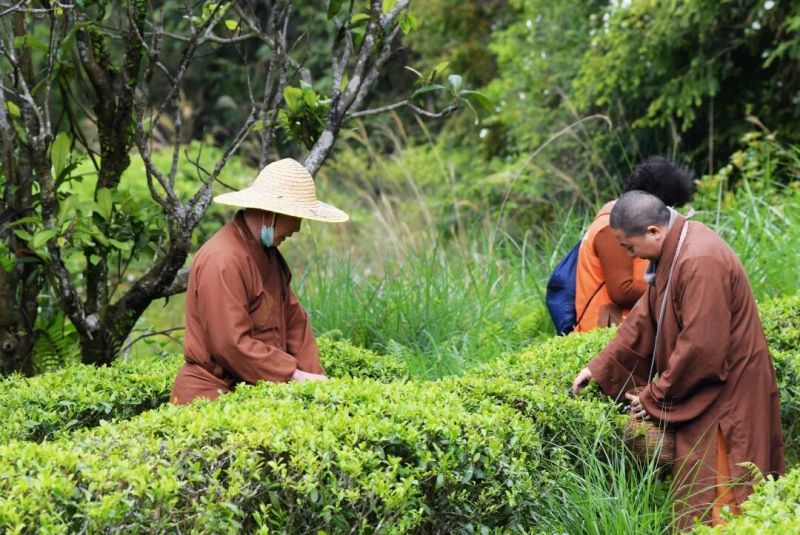
On the morning of April 19th, with clear skies, the monks and guardians of the South Shaolin Temple gathered at the Jiulian Mountain tea garden to begin their annual spring tea picking activity. After breakfast, the crowd lined up and walked into the tea garden. I saw tea ridges winding along the mountain terrain, tender buds turning green, and clouds and mist like gauze. Subsequently, the monk led the public to start the morning picking with a grateful heart. In the tea garden, the master bent down and lightly pinched the tender buds, while the layman carefully harvested them. Sometimes they exchanged tips on tea picking, and sometimes they let out gentle laughter. An old layman smiled and said, "Picking tea with the mages is particularly joyful in my heart." Several young volunteers who participated for the first time also sighed, "So labor can be so peaceful and happy The Southern Shaolin Temple has always adhered to the ancestral motto of "equal emphasis on agriculture and Zen". Picking tea is not only a way of climbing, but also a practice. Cultivate your mind while focusing on picking, eliminate my slowness while bending down to work, and cultivate gratitude amidst the lush greenery in the basket. The case of Master Zhaozhou's "Go for Tea" illustrates that tea and Zen are essentially the same - a leaf soaked in the rain and dew of the mountains, baked over fire and rubbed by hand, can achieve a fragrant taste; Practice is like making tea, it requires polishing to see its true nature. At the end of the slope, the tea leaves are fully loaded and will be left to dry, green, and knead. This batch of spring tea will be used for offering to Buddha and for bonding with believers from all directions.Green mountains remain silent, but the fragrance of tea is trustworthy. The South Shaolin Temple celebrated a joyful morning of tea picking, bringing traditional agricultural Zen to life in the present and allowing more people to experience the tranquility of "Zen in tea, Zen never leaves tea".
MORE -

The third of the four reasons for vegetarianism: based on causality
Vegetarianism: indifferent to life, inner peace·Clear heart and few desires, wholeheartedly devoted to the Tao·Cause and effect: All methods are empty. Cause and effect are not emptyThe law of causality is a fundamental principle promoted by Buddhism. Planting melons brings melons, planting beans brings beans "," doing good brings good, doing evil brings disaster ", there must be a reason for it to have fruit, and the reason for creating it will have fruit, which is an inevitable and difficult principle. Based on this reason, it can be inferred that if someone commits murder, they must be punished, and if they eat their meat, they should be returned. As the saying goes, 'eating half a catty is worth eight liang'. Individual causes, individual reports; The public causes and receives reports. There are constant wars around the world every year, and many people have died from swords and soldiers. The reason for this is due to a discerning eye.The Shurangama Sutra states: "When a person dies, they become a sheep; when a sheep dies, they become a human; when they die, they live and eat each other." This explains the principle of the cycle of cause and effect in three generations.Buddhism advocates equality among all sentient beings, and all sentient beings have Buddha nature. In the past, all Buddhas were already Buddhas, and sentient beings were not yet Buddhas. Therefore, sentient beings should not be treated lightly, let alone killed, as killing is against reason. The murderer who violates the principles of compassion and equality will reap the consequences.In 2011, Elder Wei Xian published a paper titled "Buddhism and Vegetarianism" at the Second Chongqing Ancient Sword Forum, detailing the formation and development of the vegetarian viewpoint, as well as the influence of Buddhism on it. The Buddhist scriptures and practices of vegetarianism provide four main reasons for our vegetarianism: health, compassion, causality, and spiritual practice.Article source: Paper "Buddhism and Vegetarianism" from the 2nd Chongqing Ancient Sword ForumAuthor: Elder Wei Xian
MORE -
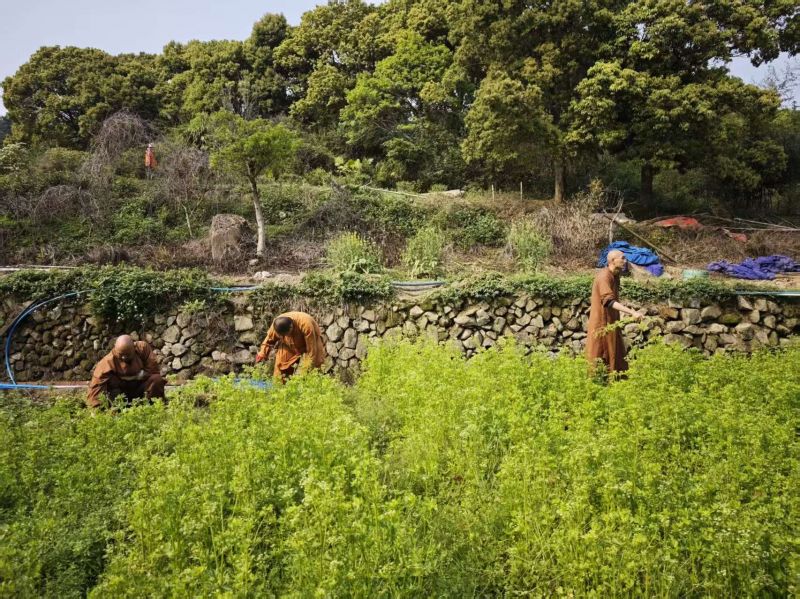
The monks and commoners walked out of the slope to pull grass, laughing and laughing lightly
The two groups of monks and laypeople bowed and pulled grass, with light laughter and joy. Remove weeds, sweep away dust from the heart, touch the soil with your hands, and have a clear and joyful heart. There is Zen in labor, and accompanying each other brings warmth. Originally, cultivation is not elsewhere, but in this daily life of diligent cultivation and joyful coexistence.
MORE -
The fourth of the four reasons for vegetarianism: based on cultivation
Vegetarianism: indifferent to life, inner peace·Clear heart and few desires, wholeheartedly devoted to the Tao·Practice: Abstinence, Wisdom, Learning, Great Compassion, Great AspirationPractice is a basic requirement for Buddhists, and through cultivating kung fu, the goal of achieving the fruit of Buddha can be achieved. The basic methods of cultivation are the three schools of precepts, concentration, and wisdom. Precepts are constraints on behavior, preventing and stopping evil, and practicing good deeds for all; It is to focus on one realm and eliminate all false distinctions; Wisdom is the ability to understand the causes and fruits, and to comprehend the realities of various phenomena. The most important thing in this is the precepts. The function of observing precepts is to absolutely prohibit disturbing sentient beings, harming the interests of others (including life and property), maintaining inner purity, goodness, and purity, and laying the foundation for cultivating wisdom. This precepts of wisdom is a common practice of the Three Ridges.To achieve Buddhahood, one must further cultivate the Mahayana Bodhisattva practice. The bodhisattva practice includes the four immeasurable minds, the four consciousnesses, and the six degrees. Its spirit is mainly about great compassion and great wishes, not giving up on sentient beings, and not harming them. Therefore, regardless of Mahayana or Hinayana, abstaining from killing is the main thing. It is an inevitable practical action to show compassion towards all sentient beings, cherish their lives, and refrain from eating raw meat.In the Mahayana scriptures, there are many discussions about killing and eating meat, both of which are cutting off the seed of compassion. Compassion is the foundation of learning Buddhism. Once this foundation is broken, one cannot attain bodhicitta or attain the fruit of Buddha. This demonstrates the importance of abstaining from killing and vegetarianism in Buddhist doctrine.In 2011, Elder Wei Xian published a paper titled "Buddhism and Vegetarianism" at the Second Chongqing Ancient Sword Forum, detailing the formation and development of the vegetarian viewpoint, as well as the influence of Buddhism on it. The Buddhist scriptures and practices of vegetarianism provide four main reasons for our vegetarianism: health, compassion, causality, and spiritual practice.Article source: Paper "Buddhism and Vegetarianism" from the 2nd Chongqing Ancient Sword ForumAuthor: Elder Wei Xian
MORE -
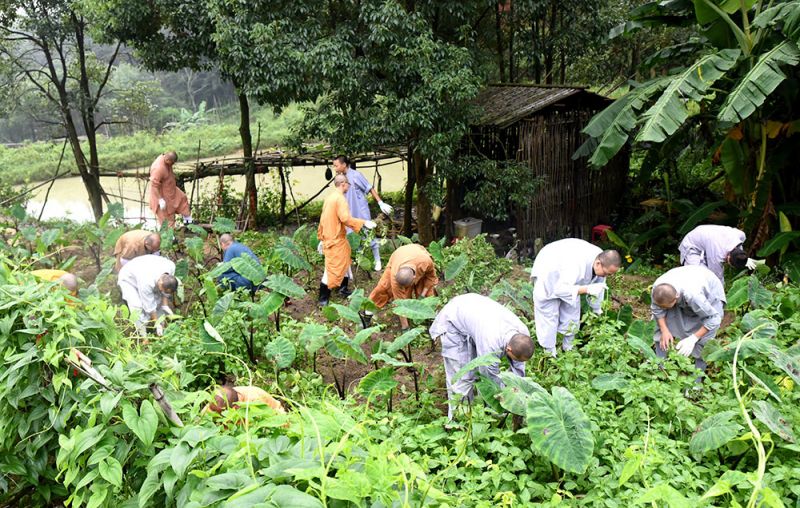
The collective labor of the monastic community, 'going out of the slope' is also a form of spiritual practice
Climbing is a form of cultivation. The Sixth Patriarch once said, "Without departing from one's own nature, one is the blessed land." Many enlightened Zen masters have been carrying firewood and water to preserve their inner nature, accumulate wealth and resources, and when the seasons and conditions arise, they will come out to bring great benefits to all sentient beings. Therefore, going downhill is not only for cultivating blessings, but also an opportunity to achieve enlightenment.At the same time, Chupo provides the public with the opportunity to engage in the maintenance and care of the dojo, unite as one, and contribute to the promotion of Buddhism, making the believers who come to the dojo happy when they see the solemn and pure environment. kindness knows no bounds.Recently, there has been abundant rainfall, and the weeds in the field have grown taller and more lush than vegetables. The mages were delighted to weed, and in less than an hour, the taro field was cleaned up.
MORE -
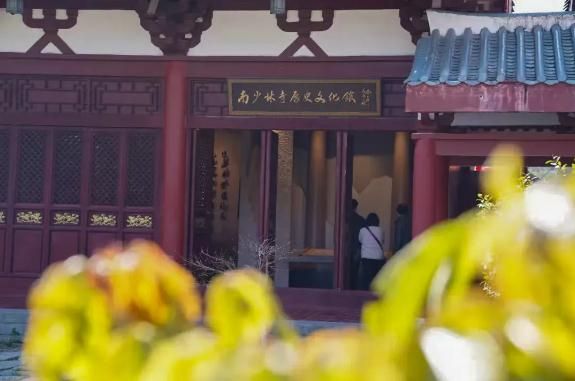
First time meeting, the South Shaolin in the eyes of a tea art teacher
First Encounter with South Shaolin TempleIn the golden September, I embarked on a journey to explore the Zen philosophy of the Southern Shaolin Temple.As one of the important temples of Chinese Zen Buddhism, Nan Shaolin Temple not only carries a profound historical and cultural heritage, but also attracts countless tourists to visit with its unique architectural style and natural scenery.At the moment I arrived at the South Shaolin Temple, I was amazed by its majestic aura. The temple is located between green mountains and clear waters, surrounded by lush forests, like a paradise on earth. Unlike the hustle and bustle of the city, this place is filled with tranquility and harmony, allowing people to instantly forget the troubles of the world.The sedimentation of history and cultureThe history of Nan Shaolin Temple can be traced back to the Southern and Northern Dynasties period, experiencing the rise and fall of multiple dynasties. The temple was originally an important place for Zen practice, but it was also destroyed due to war. But after several reconstructions and repairs, the South Shaolin Temple still retains its original historical style. The ancient buildings and relics in the temple witness the historical evolution of the South Shaolin Temple, and also show the essence of ancient architectural art.Walking through every corner of the temple, I deeply felt the profound cultural heritage of Nan Shaolin Temple. The temple preserves a large number of ancient books and classic documents, which are of great value for studying Zen culture. Through the inheritance hall and temple cultural wall, I gained a deeper understanding of the essence of Zen culture and the unique charm of Shaolin Kung Fu.Natural scenery and religious experienceThe natural scenery of Nanshaolin Temple is equally enchanting. The temple is surrounded by green mountains and rivers, with lush greenery in the mountains. Various rare vegetation, herbs, and flowers adorn it, like a natural painting. Taking a walk on the trail around the temple, breathing in the fresh air, I felt an unprecedented sense of tranquility and relaxation.During my visit to the South Shaolin Temple, I also experienced religious activities. Sitting in the Medicine Buddha altar, I felt the solemnity and solemnity. As the monk led me to sing the Medicine Buddha's empowerment mantra, I gradually felt inner peace and harmony. This experience has allowed me to deeply appreciate the wisdom and compassion of Zen Buddhism's "peaceful and far-reaching" philosophy, and has also made me cherish my current life more and be grateful for every gift in my life.The release on Sunday is even more sacred, making people feel reverence for life. This is not only giving life freedom, but also a baptism of the soul, allowing me to find peace and transcendence in this turbulent world. It taught me that every time I let go, it's for a better encounter; Every release is the sincerest blessing for life. In this boundless universe, may we all bravely pursue and freely roam like the released life.The Charm of Shaolin Kung FuThe Southern Shaolin Temple is not only renowned for its profound Zen culture, but also for its Shaolin Kung Fu. In the martial arts hall, I witnessed the wonderful performances of Shaolin disciples with my own eyes. They are agile and swift in their movements, each one revealing a unique charm and strength. This performance not only made me feel the charm and profundity of Shaolin Kung Fu, but also made me admire the Shaolin disciples who silently contribute to the inheritance of martial arts culture.insightThis trip to the South Shaolin Temple has deeply impressed me with the profoundness of Zen culture and the unique charm of Shaolin Kung Fu. Here, I not only appreciate the beauty of natural scenery, but also experience the inner peace brought by meditation. Every monk at the Southern Shaolin Temple exudes a sense of Dharma joy, compassion, and wisdom. The South Shaolin Temple is not only a great place to experience Zen culture and Shaolin Kung Fu, but also a holy land that allows people to stay away from the hustle and bustle and cultivate their mind. I believe that this trip will become a precious memory and treasure in my life.(October 2024)
MORE